




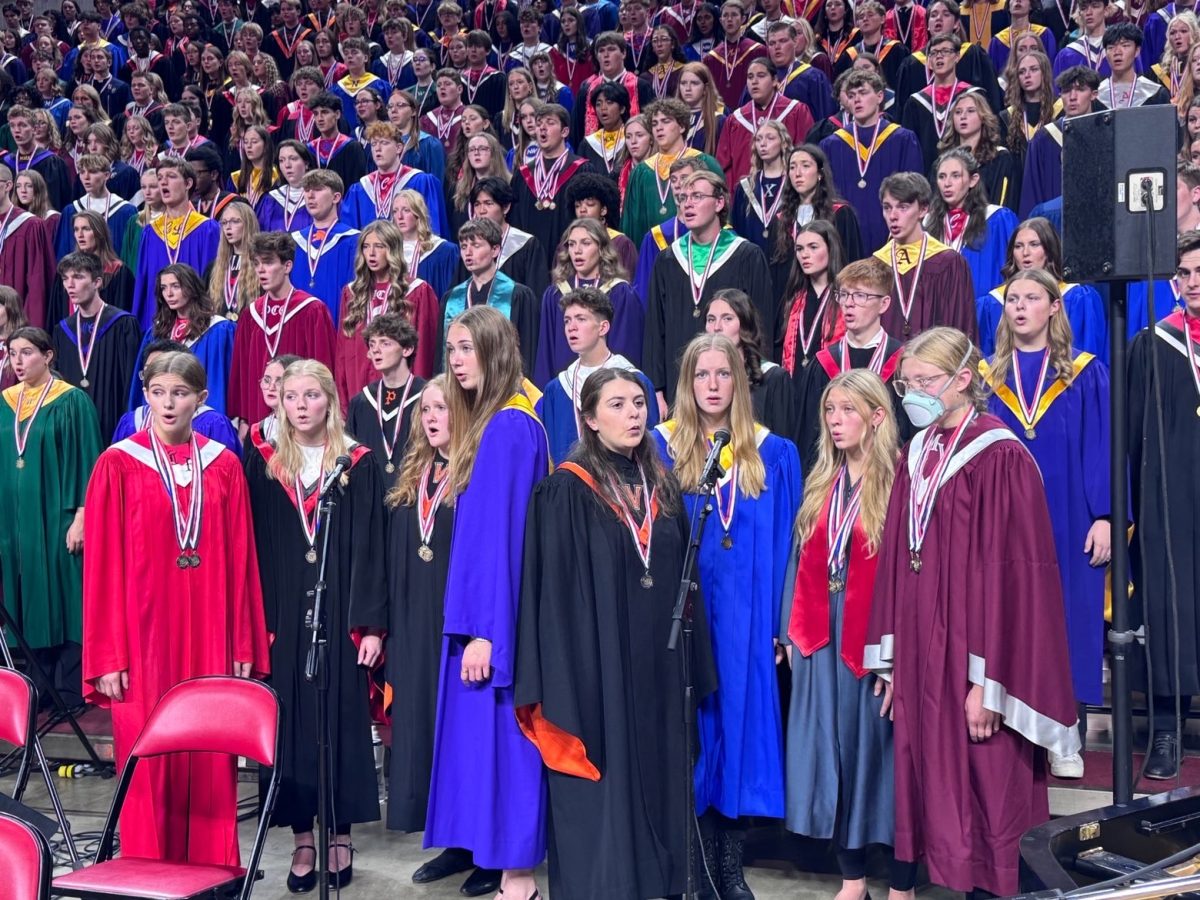
![Bass Clef Choir members Zion Ondoma, Henry Hansen, and Zerik Nicholson harmonize vocals while singing "Prayer of the Children". “[It’s] a piece dealing with the Bosnian conflicts of the ‘90s,” said Associate Director of Choral Activities Matthew Jensen, “but is applicable to what's happening today all over the world.” The students will perform the song during Large Group Contests in Cedar Falls in May.](https://riverhawkpress.org/wp-content/uploads/2026/04/20260414_111618-1200x554.jpg)





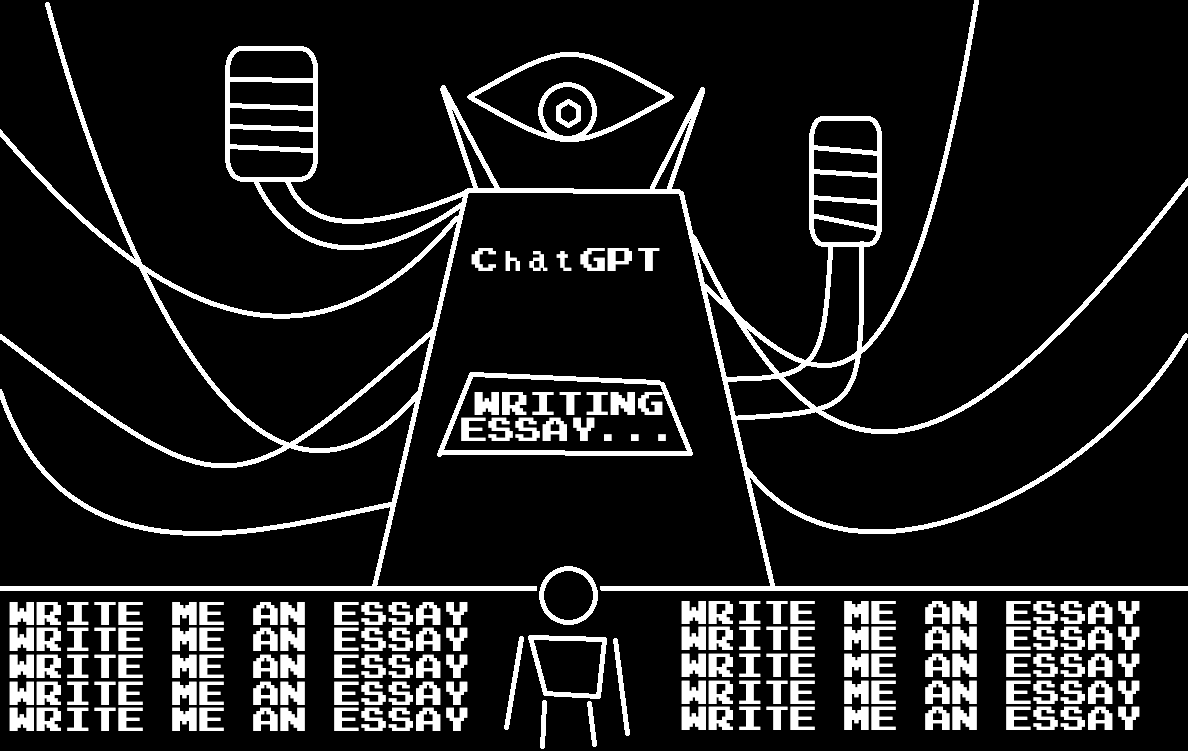
Evaluating student work has always been a challenge. However, in recent years, the emergence of generative artificial intelligence (AI) has added an additional dimension to the process of grading and evaluating student essays and started the conversation of how to identify authentic work. This issue is particularly prevalent – and controversial – in competitive writing situations like college admissions and scholarship essays.
“It’s completely changed the dynamic of how scholarships are looked at and written,” said Dawn Guritz, an English teacher at MCHS. “I think people need to be aware that they really need to be sharing their authentic selves in these examples.”
Valuing Authenticity
Following the release of Chat GPT in 2022, educators are witnessing a flood of student work and writing created by generative AIs. In fact, College Board, a national education nonprofit, recently published a study showing that as many as 84% of high school students regularly use generative AI for schoolwork. This widespread usage also extends to college admissions essays.

No Iowa universities currently require an essay for admission, but collegiate honors programs, like the one at the University of Iowa, often do.
According to Dr. Shaun Vecera, director of the University of Iowa honors program, applicants for the University of Iowa honors program are judged using a holistic approach. A student’s GPA, test scores, activities, and essay are all analyzed to determine their admission.
“[We’re] looking at, have you challenged yourself academically? If your school has AP opportunities, did you take advantage of those?” said Vecera.
As a member of the team that designs and evaluates applications for the honors program, Vecera is on the frontlines of the battle to quantify AI detection in high-stakes writing.
Starting last year, Vecera and the honors admissions team started to notice fewer essays that were fully generated by AI and more that appeared to have been “cleaned up” using a large language model (LLM), a type of AI focusing on language.
“There’s this naive view that you need to use big words or show people that you know how to use a semicolon,” said Vecera. “But those [essays] are actually fairly easy to suss out, because they don’t feel authentic.”
For Vecera, authenticity is a must. The essay prompt itself, which asks students to describe a day in their lives, demands it. In order to write a high-quality essay, then, some level of human emotion is required.
The University of Iowa honors program doesn’t use an AI detector on its admissions essays. “We would probably be unlikely to deny a student’s application only because we suspected they used AI,” said Vecera. “What a student would be denied for is probably the fact that the essay wasn’t great.”
According to an article by Psychology Today, AI often struggles to produce and describe emotion and reasoning, making the human ability to tell stories all the more valuable.
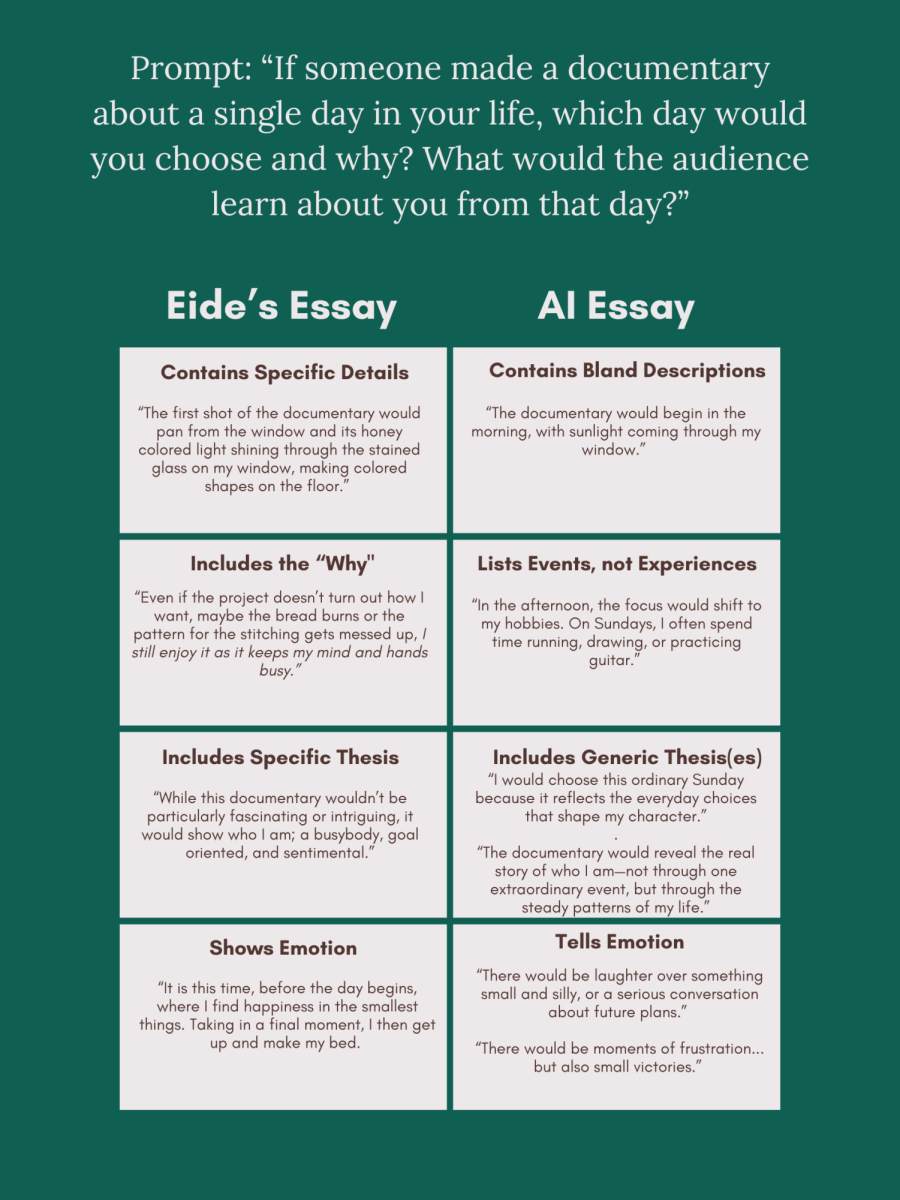
To see what this might look like, Press staff used Chat GPT to generate an essay based on the application prompt and compared the generated essay to an authentically written one by MCHS senior Kayla Eide, who was recently accepted into the University of Iowa honors program.
Eide’s essay contained specific activities she executed as well as supporting details such as why she did them, while the generated essay mentioned activities like sketching and guitar playing without the additional information.
The generated essay also contained a large amount of cliches and common experiences, including statements like, “Running clears my mind,” “I don’t just want to pass [a class], I want to understand,” and “Sundays are my reset days.”
AI Detection: An Imperfect Tool
Guritz has experienced a similar struggle to Vecera with how to detect and treat AI writing in her work helping seniors apply for the MCHS Scholarship program.
Guritz, who describes herself as a “helping guide” for students in the scholarship application process, proofreads and checks all essays for AI content to ensure standards of professionalism before submission.
“With our donors, there are several who flat out say, ‘If there’s any AI in these, we’re not giving any money,’ ” said Guritz. For this reason, essays have to completely pass AI detectors in order to be submitted.
Guritz acknowledges that the accuracy of AI detection software is spotty at best. “It’s not one hundred percent, but it’s a guide,” she said.
Guritz starts by using a Google Classroom extension for the preliminary check. If that flags suspected AI content, she double-checks with the Turnitin.com detector and often several other online options. “Sometimes I’m running them through, like, six different ones,” she said.

If the essay is consistently flagged by detectors, Guritz emails the student with suggestions on how to humanize their writing, which they are allowed to resubmit when the paper no longer shows signs of AI input.
AI content detectors like GPT Zero or Turnitin.com are a controversial subject in education due to the high frequency of false positives. A myriad of studies have produced varying degrees of accuracy, some listing accuracy levels as high as 99%, others as low as 50%.
The University of San Diego provides a published guide for its staff on how to handle AI detection in the classroom. In the introduction, it states, “AI detectors are problematic and not recommended as a sole indicator of academic misconduct,” going on to list reasons like the high likelihood for false positives and the constantly evolving nature of generative AI.
Essentially, AI detectors search for writing patterns or strategies that AI frequently uses: things like repetitive sentence structure, an analytic or impersonal voice, and em dashes are all common marks of AI that can also show up naturally in human writing.
Additionally, some studies have shown that students with cognitive disorders like Obsessive-Compulsive Disorder (OCD) and Generalized Anxiety Disorder (GAD) are more likely to be flagged by AI detectors due to the more analytical and impersonal writing style often linked to these disorders.
Vecera says that the risk of being accused of using AI is offset by evidence of human experience. “You can have a style that maybe sounds a little bit more like AI,” he said. “And yet what you’re conveying are specific and personal examples that aren’t generic.”
An Ongoing Struggle
The University of San Diego webpage concludes that most likely, AI services will never be fully accurate. “AI generators and AI detectors are locked in an eternal arms race, with both getting better over time,” it said.
“Everything’s changing to the point where, like, today it may be this, tomorrow it might be this,” Guritz adds.
One thing is clear: AI isn’t disappearing anytime soon, and the challenge it affords competitive writing likely won’t either.
However, one thing AI hasn’t figured out yet is sharing human experience, emotion, and imperfection, making the skill of writing with emotion and honesty incredibly valuable.
“What we want to see is some kind of personal connection,” said Vecera. “Give us a connection to you.”